

Whenever people complain about how “Survivor isn’t like how it used to be…” I remind myself that it has changed. Because the world has changed. And as a social experiment at its core, it wasn’t possible for Survivor to last the 26 years it’s been on our screens if it didn’t adapt to the way the world around us functions.
It’s 2026. No one wants to watch a racist, sexist, or homophobic castaway target a player simply because of their identity. But if you watch back old seasons—as great as they are—you’ll find that occasionally. However, when you compare early season remarks on gender and identity to moments like season 34’s outing of Zeke Smith, you see exactly what players won’t stand for anymore.
And it’s not necessarily because the casting team “got woke” and is now only casting Gen Z folks who identify as something other than straight. Because a lot of the people from that season were selected from earlier past seasons where the aforementioned comments were being made. It’s just that the society we live in has evolved which allows players—even returning players years later—to enter the game with a different mindset, knowing which lines can be crossed in a game of deception and which become personal attacks.

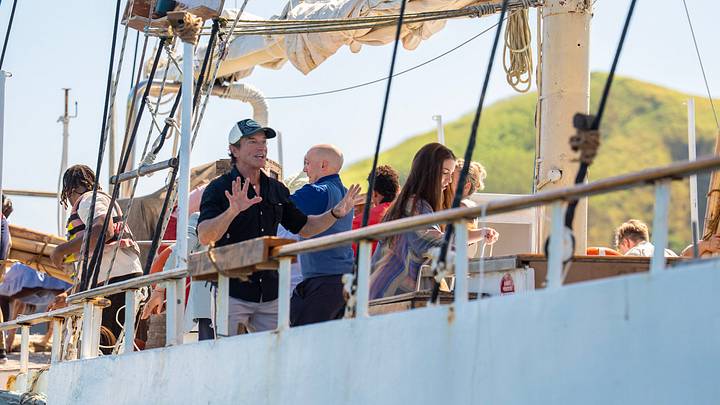
In a new interview with New York Times’ “Popcast,” Jeff Probst talks about the evolution of Survivor outside of the game. From casting and formatting to rules developed over time out of necessity and learning curves. All the pieces we don’t see on our screens that actually keep the game up-to-date not just in its own universe, but within the real world, too.
“I always saw the game as a device,” the host and showrunner explains, “so, when I was given the reins, the three things I really wanted to do was make it more cinematic, I wanted it to dive deep into [the hero’s journey]...and I wanted it to be a family show. And I knew that would change who we put on the show and the types of stories that we told.”
When the hosts ask about the difference between fan-service and evolution on the show, Probst says, “The way I always think of Survivor is a triangle: you’re either the producer, you’re the fan, or you’re the player. But we need all three, that’s how it works. And so when it comes to fans, you have to listen to what they say, and try to get at the spirit of the note of what they’re saying. It’s not always literally what they’re saying, but there’s always something there. And I think sometimes fans get frustrated if they hear me say that, that it means we’re not listening. We are listening.”
But of course, the loudest fans on the internet love to continuously share their own opinions even if they’re less than 1% of the show’s audience and don’t actually represent the majority of the viewers at home. You see so many viral posts talking about people who gave up on the show or are upset by specific changes, but Survivor is still on the air. So are the loudest voices always the most important ones to listen to?

Because upon the hosts calling the early seasons of Survivor, “a bit lawless,” Jeff responded, “You’re bringing up, just in general, a part of my history on the show that I had to reconcile and come to terms with, which is I’m not always proud of the decisions I’ve made. Not always proud of the things I’ve said on the show. There are things I said 20 years ago I would never say today.”
And as far as the updates that have been made, majority of them have been featured moments on camera. Things like how he speaks to the contestants and viewers about changing with the times. The hosts bring up him altering his challenge entry “catchphrase” of “Come on in, guys,” and ask—now that those conversations are not at the forefront of society—if he regrets changing it.
“Not one bit,” Jeff doesn’t even hesitate to say, going on about how his daughter was the one that brought up the un-gender neutral-ness of the phrase and that he wanted to be a good dad by respecting her take on it. “I don’t judge anybody for saying [guys], it’s a universal word. I’m glad I don’t say it.”
They also bring up the DEI initiative announcement made by Survivor—promising to cast at least 50% players of color every season—after the Black Lives Matter movement. They bring up the sensitivity on the topic of DEI today and wonder if anything has changed as far as Survivor’s DEI policy and once again, Jeff confirms, “Nothing has changed.”

“If you watch our show, you know we’re so diverse. And it’s not just skin color or ethnicity, it goes much deeper than that. It’s one of the biggest positive changes ever. Our stories are so much more interesting now. Because we have people from completely different walks of life. It could be birth origin…it could be birth order…if you look back at early seasons of Survivor when it was 90% white people, and mostly—at least presenting as—straight.”
“Jesse Tannenbaum who runs our casting team knows,” the host continues, “...this is what we need! We need diversity. It’s right for [the] narrative. All those differences matter in-story when you throw people together and force them to rely on each other while conspiring against each other. The more diverse the more interesting.”
And at the end of the day, Survivor needs to represent America and the viewers invested in the show. A melting pot of people from all sorts of backgrounds and upbringings coming together to experience a new lease on life is literally what America was founded on. So it makes sense that those are the same people reflected on Survivor today, tomorrow, and forevermore.
 Add us as a preferred source on Google
Loading recommendations... Please wait while we load personalized content recommendations