

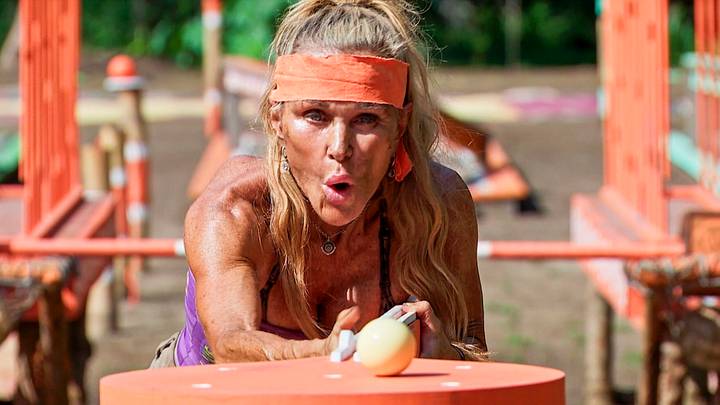
Due to the physical and social aspects of Survivor, it is often perceived as a “young person’s” game. And while the majority of castaways skew younger generationally, we very often see a player over the age of 50 completely dominate a season.
Though older players are often targeted early for being “weak” or not being able to immediately adjust to the social dynamics of their younger tribe mates, older players who make it to the merge almost consistently find their way to the finale through threat-level management, genuine social connections, and being an asset around camp.
The pre-merge vulnerability for a player over 50
Early challenges in Survivor often favor speed, swimming, and/or heavy lifting. This immediately puts older players on the chopping block as they are stereotypically viewed as weaker and slower. So if a tribe loses, it’s easy to blame the oldest person there and hope that next time they get a win.
But even when the strongest player on a tribe happens to be someone over the age of 50, the social barrier between generations often comes into play as well. We find them struggling to connect with younger tribe mates who quickly form bonds over shared interests and pop culture references.
Just this last season we witnessed this strongly with Colby Donaldson and Rizo Velovic. Colby immediately stated his distaste for the Survivor 49 finalist’s lack of work ethic and general social annoyance. But by Day 2, Colby realized he misjudged Rizo’s energy and had a heart-to-heart with him, which got Rizo emotional and bonded the two. Any other season, we might have seen—and have seen—someone in Colby’s shoes growing more and more frustrated with not understanding the younger players, effectively isolating themselves.
Statistically, 6% of players eliminated first were over 50 (going up to a whopping 38% for players over the age of 40) with that same percentage applying to players eliminated second (though less players over 40 were voted out second at 20%). 6% is very high for a show that usually only casts one person over 50 (if any) per season.
The post-merge dynamic shift for a player over 50
Once someone gets to the merge, the entire outlook on the game changes for everyone. Weakness in challenges is no longer a threat to the tribe, but rather an asset for players who want to win. The players still maintaining a good camp life for everyone are appreciated more as the days go on due to the increased cost of isolation.
Older players tend to step into a maternal/paternal role for younger players that makes them feel necessary to keep around emotionally. At this point, older castaways are routinely ignored unless explicitly needed, making them non-threats until suddenly they’re at the Final 5 or 6 and everyone looks up to decide who’s an “easy target” outside of their Final Three alliance that might also be a strong jury vote for them.
Again, a little over 6% of winners were over the age of 50 during the filming of their season. But 10% of players who come in second place fall into that age bracket. While older players have the same chance of getting voted out first as they do winning, they have an even higher chance of making it to the end, but are usually viewed as a coattail rider at that point.
How have things changed in the new era?
In the pre-Winners at War days of Survivor where the game lasted 39 days (42 in the case of Survivor: The Australian Outback), the survival aspect and camp work ethic were huge variables that could make or break a player. Both of those elements gave older players more utility value in the game than just strength or strategy.
In the new era, a faster paced 26-day game heavily relies on split-second decision making within smaller groups makes initial social integration even tougher for older players. Though challenges are less physically demanding in modern Survivor (still physically demanding, just not as much as they once were during combat-style challenges) to slightly even the playing field.
But for the most part, whether old school, new school, or new era (and we’ll see about the “open era”) older players have often faced steep early game battles, but those who make it to the merge possess high potential to make it to Final Tribal Council. And because Survivor is ultimately a social experiment, this shows that sometimes life experience and psychological adaptability are more valuable in the game than pure raw muscle.
 Add us as a preferred source on Google
Loading recommendations... Please wait while we load personalized content recommendations