

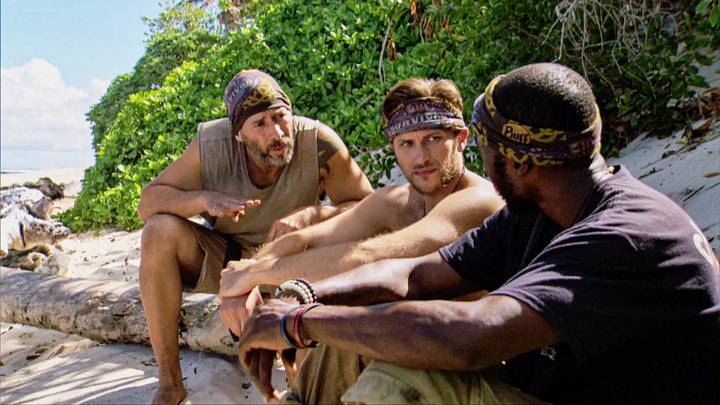
In the early seasons of Survivor, gameplay was simple, social, and physical. In the pre-merge portion of the game, tribes fought to win immunity so they could have the majority entering the merge. The more a tribe won, the more they gained strength to continue winning. Of course, we’d occasionally see tribes throw challenges specifically in order to vote out people they worried would be threats come the merge, but more often than not, the original tribe grouping dictated the alliances we would see for the remainder of the game.
In Survivor: Borneo we saw the Tagi tribe wipe out the Pagong tribe after the merge hit so they—specifically their leader, Richard Hatch—maintained control of the game until the end. Thus the idea of “Pagonging” was born: a fan-chosen name to represent one tribe being eliminated one-by-one during the second half of the game.
And we saw this happen again (Survivor: Thailand) and again (Survivor: All-Stars) until players didn’t even need to wait to the merge to demolish the other tribe in Survivor: Palau when the Koror tribe completely snuffed out every single member of the Ulong tribe until only one person—Stephenie LaGrossa—remained and they were absorbed into the Koror tribe at the “merge.” This was the only time in Survivor history when the merged tribe name was the same as a starting tribe name.

But as the game developed, and social strategy became more fluid and less about direct, Day 1, unwavering loyalty, we started to see less and less of this happening. Rather than keeping around the strongest players, tribes were eliminating the physical threats early on in order to create more immunity opportunity post-merge. We started seeing the most physical players in the series go home before the finals season-after-season.
And fans weren’t the only ones who started to notice this pattern. After being blindsided on Day 24 as a physical and strategic threat in Survivor: San Juan del Sur, Jeremy Collins knew he had to switch things up when he got a—literal—second chance on Survivor: Cambodia. This time around, Jeremy knew that his best chance of making it deeper into the game was to ensure someone who appeared as a bigger threat than himself was kept around.
So he developed a key alliance of physical, social, and strategic threats—Joe Anglim, Andrew Savage, and Stephen Fishbach, respectively—on his original tribe who he protected through the merge. Then slowly, with the focus on the “biggest threats” the three were targets for blindsides while Jeremy ran strategy to propose it was more important for someone else to go out first.

Eventually, Jeremy’s shields were all taken out, but this got Jeremy into the Final 7 players who he had social control over for the most part as well as a physical status that helped him win the final immunity challenge and guarantee his own spot at Final Tribal Council. This new strategy—along with the idea of “voting blocs” cultivated around this time—shifted the game into a new era where fluid gameplay was now mandatory in order to survive.
We’ve seen Jeremy’s strategy so many times since his win. Tony Vlachos adapted it for Survivor: Winners at War where he used Jeremy himself as one of his “meat shields.” And Aubry Bracco in Survivor 50 was to go to the end with the two people everyone else kept around as “meat shields” and easy votes.
So in creating this strategy, Jeremy didn’t just dominate the game and win with a perfect 10-0-0 jury vote, he built a permanent defensive blueprint for every season moving forward to adapt and evolve with.
 Add us as a preferred source on Google
Loading recommendations... Please wait while we load personalized content recommendations