

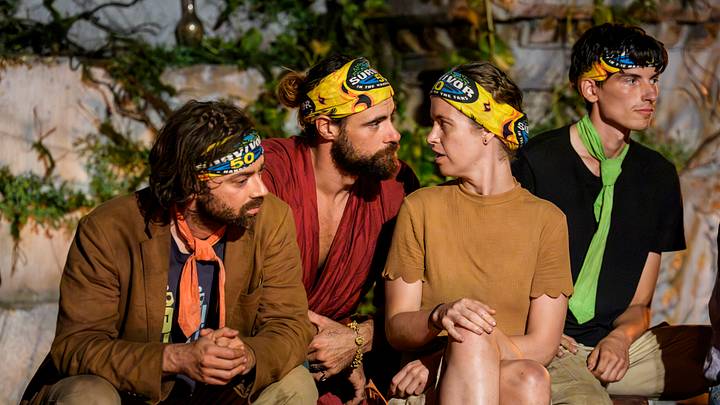
Survivor was originally built to be a social experiment, but along the way, it turned into a game of strategy and deception. Some of the best strategic moments on the show involve players lying or being deceitful in order to advance themselves in the game.
Cirie Fields in Survivor: Micronesia telling Erik Reichenbach to give up his immunity necklace as a signal to her that she can trust him (and then turning around and helping to vote him out). Tony Vlachos in Survivor: Cagayan building a “spy shack” attached to the shelter so he can eavesdrop on everyone’s conversations while they’re none the wiser (then upgrading to the “spy nest” in Survivor: Winners at War). Tai Trang promising to give Scot Pollard the second half of the Super Idol in Survivor: Kaoh Rong only to renege and withhold it at the last minute to show loyalty to a new alliance.
There are truly endless moments of deception in this game, and yet… somehow we entered the new era of Survivor and lying is the absolute lowest form of gameplay to so many players. Why? Dishonesty used to lead to incredible feats and now even the smallest of white lies sparks and emotional fallout between players. Make it make sense!
Looking at things logically, the most obvious answer is the timeline. Back when 39-day games were on the table, if players could prove that the lies they told were strategic moves to get them to the end, they were rewarded. Now in 26-day games, players are thrown into a pot of already boiling water which drives emotions higher and makes deception feel like a personal violation rather than the legitimate strategic tool that it is.
Because the 39-day game allowed people to breathe between explosive Tribal Council moments. Sure they’d come back to camp and yell at each other like they still do today (cue Ozzy Lusth calling John Cochran a “wiener” for flipping in Survivor: South Pacific…iconic!) but then days passed before the next Tribal Council, allowing them to regroup with themselves and their alliance and just straight up calm down.
Like I said, players stew in the fire during a 26-day game without the time and space needed to cool down between Tribal Councils. Because by the post-merge game, nearly all Tribal Councils have barely a day between them. Tensions run high and when they don’t have the time necessary to release, they only continue to build up resentment towards each other rather than stepping back and getting a chance to remind themselves that it’s just a game.
But the timeline isn’t the only thing changing—society is changing as well. When the show first premiered, it was not societally okay for people to talk about their feelings publicly, especially men. So as the show evolved and the castaways’ generational impact adjusted, showing a social shift. Contemporary culture encourages people to share their feelings, with people often using “therapy speak” to express themselves—whether correctly or incorrectly.
For the first time in Survivor history, we’re seeing players talk through betrayals in real time rather than holding it all in until they can yell at people as a Final Tribal Council jury member. They prioritize their own emotional safety by being radically transparent about their feelings because that part of the game is the hardest to separate from real life. You can’t tell yourself not to feel something, even if logically you know it’s just a game.
I always thought the saying, “sticks and stones may break my bones, but words will never hurt me,” to be totally bogus, but hey…I’m now the age of the average Survivor player. So it makes sense that a similar mindset has been guiding the game over the ten seasons. Plus, with the rise of social media, players are aware now more than ever about the consequences of perception and are desperate to hold onto their own narrative rather than let others assign labels to them.
Like the entire “honesty and integrity” alliance in both Survivor 48 and Survivor 50. They were so convinced that they needed viewers to see them playing an “honorable” game that they ultimately just became hypocrites when they eventually had to go against their allies because that’s the name of the game. Survivor forces players to cut throats, stab backs, and betray people because at the end of the day, you’re there to win $1 million, not 1 million hearts (sorry, Bhanu…).
So when we see players being hyper reactive to lying, it isn’t them just being “soft.” It’s a logical adaptation to the game’s social experiment foundation. Cultural context has changed, so the game has too. And while deception is still the heartbeat of Survivor, in my opinion, the hardest part of modern seasons isn’t pulling off the lie, but surviving the wake it brings.
 Add us as a preferred source on Google
Loading recommendations... Please wait while we load personalized content recommendations